


What is the significance of the turkey for research culture? And what can we learn from chickens about working conditions?
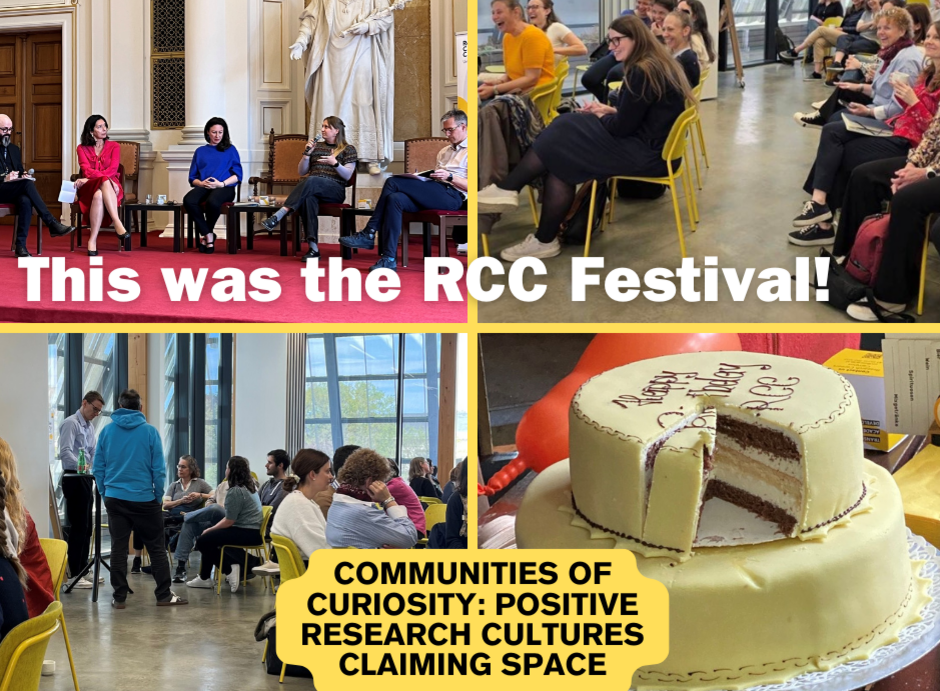
On April 22 and 23, 2026, the Research Careers Campus (RCC) at the University of Graz hosted its inaugural festival “Communities of Curiosity: Positive Research Cultures Claiming Space.” (Full programme at the bottom of this report!)
Researchers at all career levels, members of the University of Graz leadership, third-space professionals/researcher developers and higher education experts from across Austria and beyond explored supportive, creative, and inclusive research cultures in academia. Unexpectedly, day 1 of the festival brought up discussions around turkeys, while Day 2 included a deep dive into chicken research.
The first festival day, taking place in the University of Graz main hall (Aula) and, in the evening, in Kombüse’s beer garden, was festive (with an opening address by Uni Graz rector Peter Riedler) but also interactive. The second day, in the splendid Unicorn rooftop space, was more intimate and even more interactive, with colleagues moving around the venue from talks to working groups to interactive lectures to panel discussions to the buffet tables.
Here are insights into what was discussed on day 1:
International scholars who come, for example, to Graz bring with them the research cultures they experienced in their previous academic institutions – these experiences need to be recognised and appreciated (point made by translation scholar Şebnem Bahadır-Berzig).
How it feels to have a full, varied career before entering academia, how knowledge of the academic career system is (not) accessible, how “intersectorally mobile” scholars are an asset for research teams and why they can feel isolated (made tangible by Nicole Brown in her keynote, when talking about her own professional journey).
How ableism in academia can inhibit disclosure of disabilities and chronic illnesses, due to fear of career setbacks; thatthe more senior one gets in academia, the less adjustments are available – the solution is making academia a positive working environment for everyone (universal design).
Obstacles for creativity were discussed: academic hierarchies, perverse incentives, and not being prepared for the reality that research is “messy”; the interesting potential of a department structure replacing the traditional chair structure in Austrian academia; and also the “’empty’ terms of research policy” (points made by Thomas König).
That there can be career dangers in being too creative in one’s research approaches (particularly concerning interdisciplinary and cross-disciplinary collaboration).
There’s an art to creating really good spaces for collaboration and mutual enrichment (also called “structuring the s**t out of facilitation”), described by Carolyn Defrin.
We need to reassess if institutional and funding structures of the sector that promise to spark creativity actually do so (Aleksandra Kanjuo-Mrčela).
Why, in Nicole Brown’s LEGO experiments (= portray your situation with LEGO bricks), doctoral researchers may depict their supervisors as turkeys (or Darth Vader) and how such perceptions may be changed.
Here’s an insight into what was discussed on Day 2:
Academic workplaces in the physical sense: How can we expect creativity and self-governance to work if some people can’t be in the actual rooms (be it for visa reasons, for care reasons, for accessibility reasons, geopolitical reasons …)?
How can we create spaces that encourage social connection and creativity (i.e., lunch break spaces, good access)?
Good hiring practices and a welcoming department culture can have a snowball effect and a positive impact on the university as a whole.
Academic kindness needs professional stability (not precarious conditions) and a certain quality of academic life.
To reduce career precarity, solidarity and collective (unionised) efforts are needed, not focus on individual strategies; the “Plan B” to academic careers is also a collective, institutional responsibility.
What are the metrics/key performance indicators and funding models that help us to create the kind of culture that is needed today in academia, and which metrics should we retire?
How failure needs to be part of the research effort, and accounted for in funding; how wasteful it is to invest much of a researcher’s time in proposing future research projects that are never granted.
The tension between the negative effects of “managerialism”, administrative overload and bureaucracy, and ensuring that the rules for good, ethical research conduct and transparent progression are in place and observed.
Ways to get to a space beyond “taboo” discussion topics and towards true academic freedom.
How researchers should not become “super chickens” (as Geraldine Fitzpatrick termed it in her talk) but rather try to establish super collegiality to develop collective resilience strategies and be more productive in a collaborative manner.
What else happened?
A fantastic three-times-three-minutes insight into the research culture-changing “Ambassador” projects: from a handbook for inclusive and history-aware arctic research, to open science practices spreading across Graz and beyond, to queering botany education - we're so impressed by what our research community does on a daily basis to make academia a welcoming place!
A „human mentimeter“ showed the diversity of people (in academia) and was used by Geraldine Fitzpatrick to demonstrate the importance of inclusive approaches to academia
A quiz in which the COARA (Koala?) agreement, the Salzburg Principles and the Arqus European University Alliance were celebrated and gimmicks like an Arqus backpack, a Uni Graz duck or Mirjam Müller’s book “From PhD to Professorship” were won. One lucky (and smart!) festival participant (= research manager and MSCA expert Harald Kleinberger-Pierer) won a prize (a candle) for knowing the exact date of the MSCA PD submission deadline!
The RCC was called the „liquid between more rigid structures“ by Vice-Rector Joachim Reidl; Vice-Rector Mireille van Poppel gave examples of failure-friendly practices in departments, inspired by the RCC‘s work.
The people who came together (our supportive University of Graz leadership, researchers and colleagues, but also some who travelled from Tyrol, Carinthia, Vienna, Germany, Croatia, Canada, Slovenia and the other universities in Graz) were so warm, and so interested in each other and our work here in Graz.
Positive research cultures do not arise by chance but result from intentional community-building and a constant effort for inclusivity and well-being. The Research Careers Campus is committed to continuing this conversation and to doing its part in creating an environment in which every researcher can thrive. We're very grateful that so many people engage with us and contribute to the wonderful community we have at the University of Graz.
Look out: the next date for this format will be in April/May 2027 (one day only this time, we have to stay humble)!
(Report: Johanna Stadlbauer, Gerald Lind, April 24, 2026)
Full programme:
Communities of Curiosity: Positive Research Cultures Claiming Space
April 22 and 23, 2026, Aula & Unicorn, University of Graz
Event Hosts: Johanna Stadlbauer (RCC Head) & Gerald Lind (RCC Deputy Head)
April 22, 2026 (AULA, Universitätsplatz 3, 1st floor)
12 pm: Community lunch
1:00 pm: Official Opening
Welcome by Rector Peter Riedler (University of Graz)
Interview with Vice-Rectors Joachim Reidl & Mireille van Poppel
1:30 pm Opening Keynote: From isolation to connection: communities shaping research culture
Opening talk by Associate Professor, Institute of Education Nicole Brown (University College London)
2:45 pm Round Table: What nourishes researchers and feeds research creativity?
Janne Creve, Doctoral Researcher, Functional Diversity and Ecology Research Group, Member of the RCC Strategic Advisory Council (University of Graz)
Carolyn Defrin, MSCA Postdoctoral Fellow and artistic researcher (University of Graz)
Aleksandra Kanjuo-Mrčela, Professor of Sociology (University of Ljubljana)
Thomas König, Managing Director of FORWIT (Vienna)
4:00 pm Reflections and Intentions
Geraldine Fitzpatrick (Vienna University of Technology)
April 22, 2026 (KOMBÜSE Graz, Erzherzog-Johann-Allee 2, 8010 Graz, Stadtpark)
6.30 pm to 8.00 pm: 15 Years of Supporting Research Careers
Cake & drinks to celebrate the first 15 years of research career support institutions at the University of Graz
April 23, 2026 (UNICORN, Schubertstrasse 6a, Conference Deck)
10:00 am: Interactive welcome by Johanna Stadlbauer & Gerald Lind (University of Graz)
10:15 am: Panel: What are the structures we need to replace and build to allow for productive research?
Klemens Fellner, Professor of Mathematics and Dean of the Natural Sciences Faculty (University of Graz)
Verena Régent, Senior Researcher (WPZ Research Gmbh, Vienna)
Katta Spiel, ERC Starting Grantee, member of Austrian Monitoring Committee on the Implementation of the UN Convention on the Rights of People with Disabilities, and ÖAW Young Academy (Vienna University of Technology)
Milica Popović, Senior Postdoctoral Researcher in Cultural Studies (Austrian Academy of Sciences, Vienna)
11:15 pm: Building and replacing: Working groups for a kind academia
Klemens Fellner (University of Graz) & Domenic Hofmann (MedUni Graz)
Verena Régent (WPZ Research Gmbh, Vienna) & Julia Taucher (University of Graz)
Katta Spiel (Vienna University of Technology) & Silvana Weiss (University of Graz)
Milica Popović (Austrian Academy of Sciences, Vienna) & Regina Lammer (University of Graz)
12:30 pm: Collegiality Showcase: The Research Culture and Integrity Ambassadors Introduce Themselves in three minutes
This session showcases projects awarded in November 2025:
Sarah Bürli, Sophie Döhrn and Hannah Schrettle: “From Roots to Words: Rethinking How We Speak About Plants (and Us)”
Florina Schalamon: “Sermilik Handbook for a Safe, Inclusive and Responsible Arctic Research Culture at the Sermilik Research Station”
Živa Korda, Hilmar Brohmer, Gaby Hofer, & Carmen Pizka: “From Principles to Practice: Fostering Open Science in Graz”
1:00 pm: Your good academic life: small actions, collective impact Keynote and creative space
Geraldine Fitzpatrick (Vienna University of Technology)
2:30 pm Takeaways and Future Plans
Vice-Rector for Internationalisation and Equal Opportunities, Mireille van Poppel (University of Graz)