


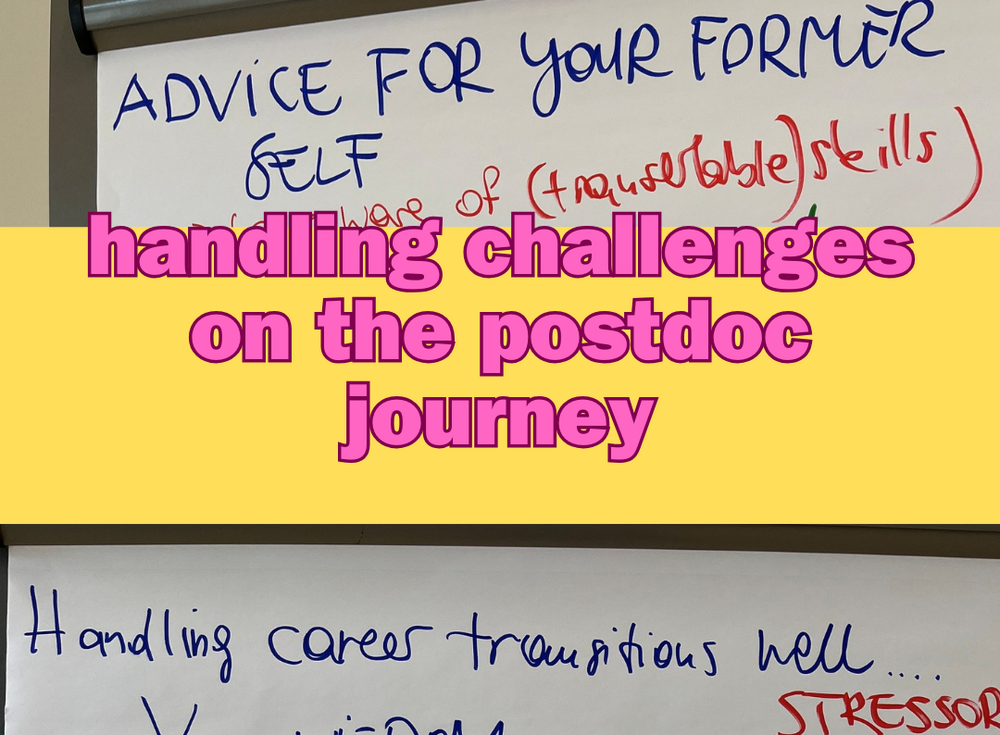
The Research Careers Campus team works with the conviction that our community has wisdom to share with each other, and we love creating the spaces for this. Sometimes, dedicated reflective exercises (such as can be found on the Prosper portal) bring up a lot of inspiring material!
Here are some insights from recent encounters with researchers in different contract types and career stages, who discussed their strategies to cope with common occurances in research careers - and further below some options we at the RCC like to suggest.
First up: What are these challenges in a “normal” research life that we hear about?
- Time-limited, project-based funding that can make life-planning difficult
- Mobility that comes with changing employers or taking up opportunities in different countries, associated are also residence-permits that can quickly end if a contract ends
- Political changes in governments that can suddenly end funding for projects
- Wars breaking out that make destinations inaccessible
- The gamble of successful funding applications
- Maintaining important, nourishing personal relationships throughout career and location changes
- New academic systems can feel opaque or are seemingly intentionally intransparent
- Institutional information isn't as accessible as it should be
- Being unsure if this career is right for you, or being very sure but unsure of your chances of remaining in academia
Second: What has helped our scholars in the past, and what have they learned looking back?
- Consistent exercise routines and pursuing community-based hobbies are helpful when “crisis” hits
- A strong foundation in a community or a faith is felt as stabilizing
- Not engaging in future catastrophy scenarios, taking things step-by-step
- Cultivating relationships with helpful mentor-figures, who take their responsibility seriously and actively help ("sponsorship")
- A strong sense of passion for one's field, a constant investment into one's expertise, one's niche
- A strong sense of not accepting things as they are / spirit of resistance can lead to opening your horizons wider
- Realizing that one's skills are indeed transferable, and academia is not the only option
- Becoming more intentional and strategic about which opportunities to pursue
- Taking up growth opportunities
- Reflect and be in touch with one's intrinsiv motivation and drivers
- Learning to step away into a calmer mindframe, waiting to make decisions or taking action
- Cultivating a mindset of “I have a choice”
Third: What else is useful?
- Equip yourself with information to understand the system you are navigating (for University of Graz, e.g. familiarity with strategic planning and university funding through reading the three-year “Leistungsvereinbarungen” and the “Entwicklungsplan” documents, familiarity with contract types and roles through reading the “Betriebsvereinarung Wissenschaftliche Karriere”, available in the internal system)
- Take part in trainings and expert talks to receive crucial information on certain aspects of research life (such as Auf dem Weg zur Professur? Training zur Vorbereitung auf Berufungsverfahren in September, Negotiating on your path to a professorship on Jun 10)
- Use the service units at the University for all parts of your work life (like conflict resolution, equal opportunities, university teaching, publishing services, research funding advice, …)
- Use 1:1 coaching offers with experienced advisors (like ours)
- Take part in peer networks, built external mentoring relationships with more experienced colleagues and make use of the relationship with your managers, who are responsible for giving you access to resources you need for your research and for your career development
Report: Johanna Stadlbauer, RCC, 16.4.2026