



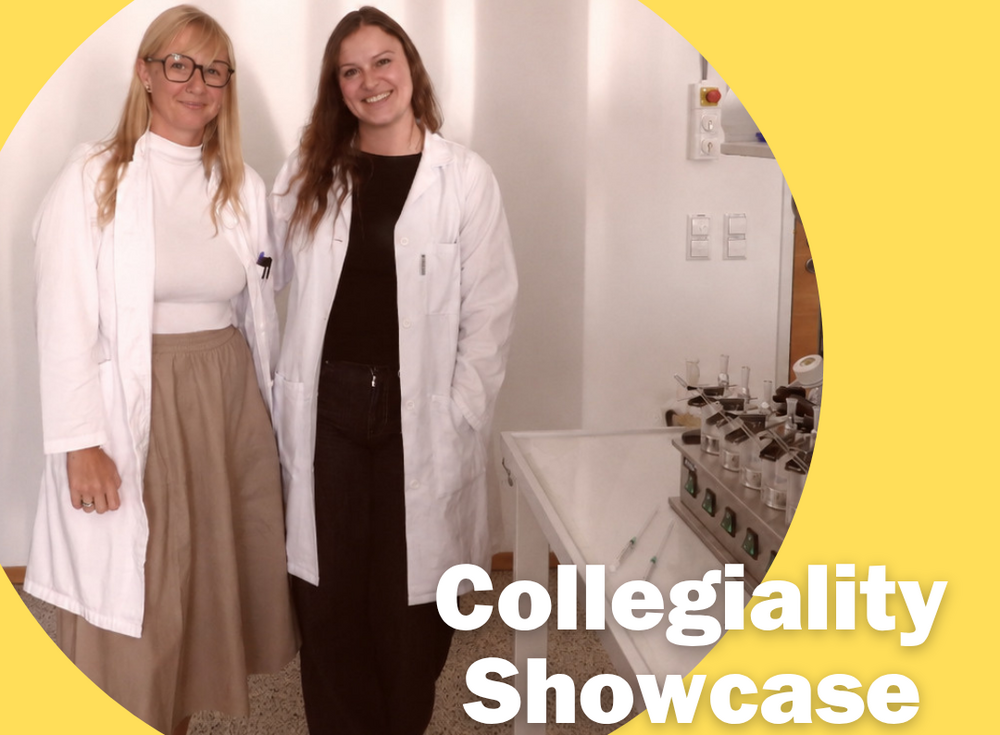
Who are the lab mates who are incredible at creating a healthy, supportive, and nurturing environment for everyone in the research group? Let us introduce two of them: Laura Wiltschko-Lamprecht and Ramona Jeitler, from the Institut für Pharmazeutische Wissenschaften, who work in Eva Roblegg's group on drug delivery and advanced manufacturing.
Here are their three answers to our three questions.
1) Which activities for contributing to a positive research environment are most important in your view, and what is your personal contribution to this cause?
Academia is a highly competitive environment. Researchers are constantly evaluated by their scientific output, publications, funding and impact, while positions and resources are often limited. We think we should be honest about the pressure this creates rather than pretending it does not exist. At the same time, we strongly believe that scientific excellence and a positive working environment are not contradictory. Quite the opposite: people are most creative, curious and capable of performing at their best when they feel well, both mentally and physically, and when they feel safe enough to ask questions, make mistakes, learn from them, and feel that their efforts are validated.
Being in a more senior position also means having some influence on how younger researchers experience academia. We both try to use this influence consciously. For us personally, this means maintaining high scientific standards while giving early-career researchers the space and support they need to develop their own ideas, confidence and independence.
We also see a broader responsibility in this. Much of our research is enabled by public funding, and we believe we therefore have a responsibility to use this privilege in the best possible way for society. This means generating new knowledge and scientific progress, but it also means educating and supporting the next generation of researchers. The people we train today will shape the science of tomorrow, and the way we treat and mentor them is part of our contribution to society.
2) What do you personally get out of your engagement?
We think we also need to be honest about the fact that actively investing in people and in your working environment takes time and energy – resources that are then not available for your own scientific career. In a highly competitive system, choosing collaboration over competition and taking responsibility for others may sometimes mean accepting that you will not always be the person with the highest output or the most impressive track record.
Additionally, it can also be emotionally demanding. Investing in people means caring about their development, their challenges and sometimes their struggles. But for us, the benefits clearly outweigh these costs. By investing in the people around us, we also have the opportunity to build long-lasting, honest and meaningful collaborations and professional relationships and we hope to inspire young people to pursue and enjoy science .
Ultimately, we are helping to create an environment in which we also want to work ourselves: one based on respect, openness and trust, where people have the opportunity to be seen and heard. For us, this is a different measure of success – perhaps one that is less easily captured by publication numbers, funding or other academic metrics, but one that we personally find deeply valuable.
3) What would you suggest to others who want to take first steps for becoming active in co-creating their working environment?
Start within your own sphere of influence. You do not need to be a professor, group leader or PI to contribute to a positive research environment. The way we communicate with colleagues, share knowledge, respond to mistakes, give feedback and support someone who is struggling all contribute to the culture of a workplace.
We would also encourage people not to underestimate small actions. Take the time to answer a question. Share your experience instead of guarding your knowledge. Give credit to others. Listen. Be constructive when something goes wrong. And remember how it felt when you were the least experienced person in the room.
We may not be able to remove all the competition and pressure inherent in academia. But each of us can contribute to creating the environment we would like to work in ourselves – and the environment we would have wanted to encounter when we first entered science.
Thanks a lot for taking the time to answer our questions - and thanks to Atiđa Selmani, who suggested her colleagues for an interview!
The Research Careers Campus Graz showcases people and networks which shape our research environment here in Graz - towards a more collegial, friendly and diverse academia, where all research talents can thrive. More here.
Picture credit: Jeitler/Wiltschko-Lamprecht, privat, Interview: Johanna Stadlbauer, RCC, 25.8.2026