


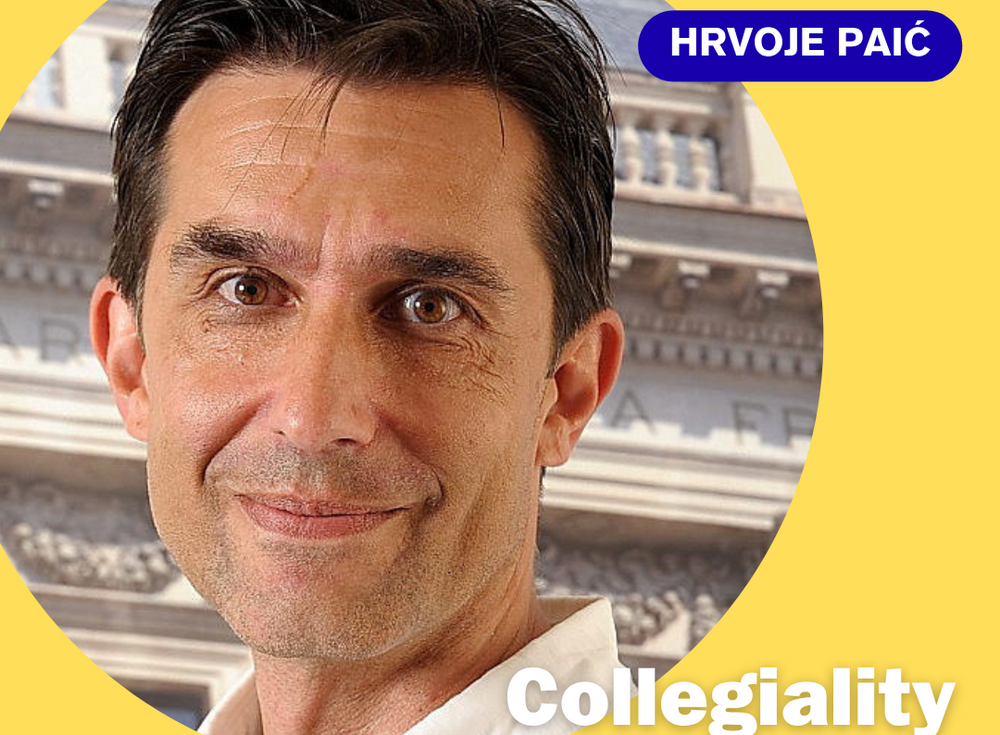
Who are the colleagues who question traditional conservative power relations in academia? Who relate to each other in radically democratic ways? We've asked Senior Lecturer and academic coordinator of the doctoral programmes at the Centre for Southeast European Studies, Hrvoje Paić!
Here are his three answers to our three questions.
1) Which activities for contributing to a positive research environment are most important in your view, and what is your personal contribution to this cause?
As the co-speaker and academic coordinator of two PhD groups at the CSEES/GITS, University of Graz, I am committed to fostering a research environment based on respect, academic empathy, curiosity, collegiality and solidarity. I see PhD researchers not as students who should passively and uncritically follow their professors, but as respected colleagues and equally valuable members of our academic community. Through initiatives such as the PhD Retreats, PhD Event Series, PhD Book Presentation Series, PhD Film Discussion Series, Seminar PhDs-for-PhDs (Doctoral Skills Lab) I create spaces in which doctoral researchers can exchange ideas, include and develop their own perspectives, take responsibility and participate actively in academic life. I also work to facilitate excursions and collaborations with other research groups beyond our university (such as University of Leipzig and University Zagreb), opening up new opportunities for intellectual exchange and collective mutual learning.
My central goal is to nurture a new generation of scholars who can enrich academic knowledge production, who are empathetic and respectful toward their research field and their colleagues, who are self-confident and socially responsible. Or in other words, my goal is to support something that can be called academic love atmosphere toward the production of knowledge and the people with whom they share this endeavor.
2) What do you personally get out of your engagement for a more collegial academia?
For me, contributing to innovative, solidary, respectful and collegial academia is not simply a professional responsibility but a deep personal and intellectual commitment. I find great satisfaction in seeing doctoral researchers gain confidence, respect each other, develop their own voices, and recognize themselves as independent scholars rather than followers of established academic authorities. Their curiosity, creativity, willingness to challenge established assumptions and in doing so have courage to follow unconventional new paths of research also enrich my own thinking and remind me that knowledge flourishes through dialogue and courageousness rather than hierarchy. This engagement is particularly meaningful in a time when the neoliberalization of academia increasingly threatens solidarity, empathy, and the intrinsic joy and love for intellectual work. What I gain most is the conviction that we can help create an academic culture in which scientific excellence and humanity reinforce one another rather than stand in opposition.
3) What would you suggest to others who want to take first steps for becoming active in co-creating their working environment?
One of the most formative influences on my own development was my PhD mentor, Eva Kreisky, during my studies who tried to relate to students in a radically democratic way, opening avenues of freedom, constantly challenging conventional academic hierarchies and encouraging them to become independent thinkers. This experience shaped my conviction that I should not understand myself as a leader who directs others, but instead of a leader, as a provider, supporter, mediator, and facilitator of PhD researchers’ development.
I would encourage emerging academic leaders simply to stop being leaders. Or in other words: to work constantly on dismantling their own authority and authoritarian position in the field that is always connected to leadership, also academic one. In doing so, I would suggest these colleagues to question academic conservative traditional power relations, to think about leadership as element that reduces academic creativity and innovation, to listen and take into account seriously those who work with them, to learn from and together with them, to learn to accept to be overvoted by their collaborators and see it as compliment, and also, to co-create conditions in which everyone can contribute as an equal intellectual partner. Work on so called leading positions should be measured not by how effectively colleagues follow or how much third-party-funding has been acquired, but by how successfully academic environment and atmosphere enables PhD researchers and other academic colleagues including colleagues on administrative positions to become much more respected, self-confident, responsible and as consequence more innovative.
Above all, I would encourage colleagues to actively defend respect, solidarity, empathy, and intellectual enthusiasm as fundamental academic values, especially in a university landscape increasingly shaped by technocratism, managerialism, bureaucracy, elbowing for positions, academic power and rule rivalry and other neoliberal pressures. Or, my suggestion in other words, words of Lou Reed would be: Walk on the Wild Side!
Thanks a lot, Hrvoje Paić, for taking the time to answer our questions!
The Research Careers Campus Graz showcases people and networks which shape our research environment here in Graz - towards a more collegial, friendly and diverse academia, where all research talents can thrive. More here.
Picture credit: CP Pictures Graz, Interview: Johanna Stadlbauer, RCC, 13.10.2026