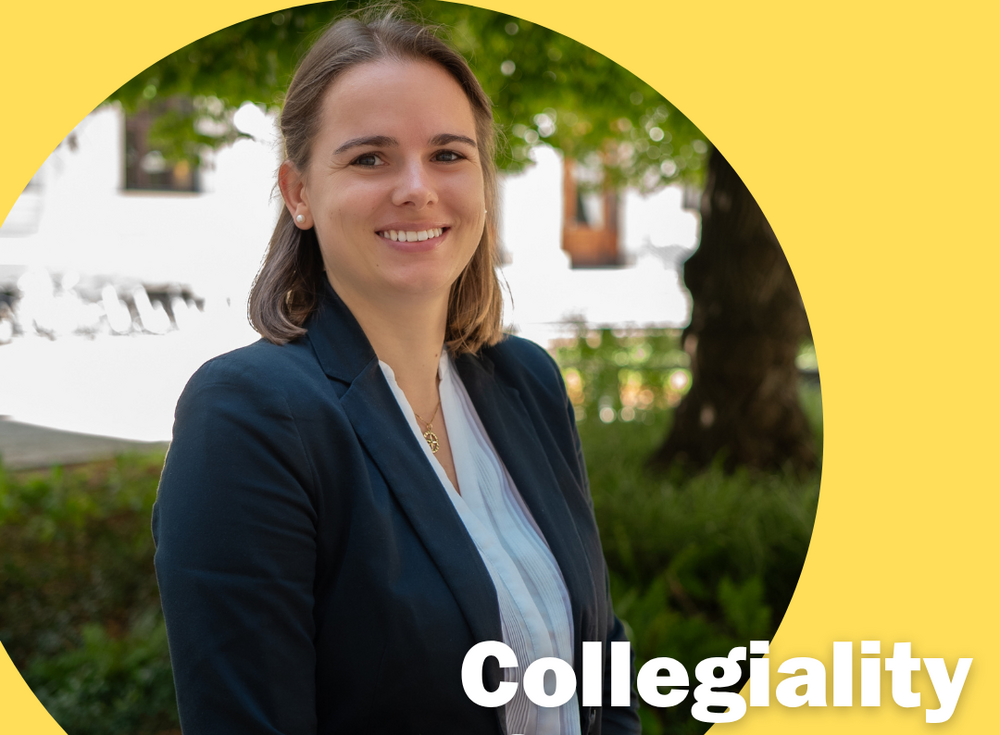
Who are the PhD researchers who are taking up leadership roles and foster networks for exchange across the disciplines? Let us introduce one of them: Petra Zandonella, legal studies PhD researcher and PhD-spokesperson of Human Factor in Digital Transformation.
Here are her three answers to our three questions.
1) Which activities for contributing to a positive research environment are most important in your view, and what is your personal contribution to this cause?
In my opinion, it is important for researchers to engage in regular dialogue with other researchers both nationally and internationally, within and across disciplines, in order to maintain a critical perspective on their research and to generate new ideas. Unfortunately, aside from the doctoral colloquia, this does not yet exist for PhD students in a structured way at my faculty. However, there are already formats for exchange, for example within the RCC or in (RCC or project) consortia. A positive example for me is the Human Factor in Digital Transformation (HFDT) research network, in which various disciplines (economics, law, philosophy, psychology, sports science, systems science, etc.) conduct research on the topic of ‘digital transformation and how to keep digital transformation human’ and meet regularly to exchange ideas. I am very grateful to have been part of this network since the beginning of my PhD in law.
A highlight of our collaboration is the annual Open Science event at Schöckl (a mountain near Graz), where each year a different theme is presented and discussed from multiple disciplinary perspectives. What makes HFDT special is the spirit of mutual respect in the discussions, regardless of one’s position or role.
We PhD students have also been practising this spirit of collaboration at our monthly lunches and for over three years now at the HFDT-PhD-writing retreats. Although the focus of these retreats is on individual work, the exchange of ideas across disciplinary boundaries is valued and fostered in a respectful manner. We have just returned from our latest writing retreat in Burgenland, with writing flow and many new ideas.
As the HFDT-PhD-spokesperson, it was a pleasure for me to organise this event and to help create a space for respectful collaboration. I’m very grateful for the opportunity and institutional support (especially from the HFDT research network and the RCC) that make such events possible.
As early-career researchers, we often do not have the power and influence to shape the research environment and the institutional boundaries as we would like. Therefore, we need support from our supervisors or from established institutions.
2) What do you personally get out of your engagement?
My involvement in the HFDT research network enriches me intellectually by constantly providing new perspectives on my own research and insights into other areas of research. As HFDT-PhD-spokesperson, I can act as a link between the PhD students, facilitating constructive exchange even at this stage of our careers. Through ongoing dialogue with researchers from a wide variety of disciplines, I am constantly learning and developing my skills, both academically and personally. I particularly value this collaborative environment, which challenges my thinking, broadens my horizon and strengthens my ability to communicate ideas across disciplinary boundaries.
3) What would you suggest to others who want to take first steps for becoming active in co-creating their working environment?
Identify what you would like to change or develop further: If something is bothering you, that can be a useful starting point. Equally, if you want to continue an existing initiative, perhaps because the person who originally led it has left the university or has other commitments or you want to support the existing team, this can be a good opportunity to pick up the thread and carry it forward.
Look for like-minded people: In my experience, there are always people with similar feelings, wishes or ideas, and it is easier to get things off the ground when you work together. Joint projects foster a sense of community, but they often also lead to an academic exchange. In my experience, you can benefit in two ways: academically and socially.
Get started: The RCC team is open to new ideas and is always willing to support them with advice and organisational and/or financial resources. However, there are also numerous other organisations at the university that are delighted when someone wants to get involved. Reaching out to them, sharing your ideas, and asking what support is available is often all it takes to get started.
Thanks a lot, Petra Zandonella, for taking the time to answer our questions!
The Research Careers Campus Graz showcases people and networks which shape our research environment here in Graz - towards a more collegial, friendly and diverse academia, where all research talents can thrive. More here.
Picture credit: Uni Graz/Radlinger, Interview: Johanna Stadlbauer, RCC, 27.7.2026