Begin of page section:
Page sections:

  • Go to contents (Accesskey 1)
  • Go to position marker (Accesskey 2)
  • Go to main navigation (Accesskey 3)
  • Go to sub navigation (Accesskey 4)
  • Go to additional information (Accesskey 5)
  • Go to page settings (user/language) (Accesskey 8)
  • Go to search (Accesskey 9)

End of this page section. Go to overview of page sections

Begin of page section:
Page settings:

English en
Deutsch de
Search
Login

End of this page section. Go to overview of page sections

Begin of page section:
Search:

Search for details about Uni Graz
Close

End of this page section. Go to overview of page sections


Search

Begin of page section:
Main navigation:

Page navigation:

  • University

    University
    • About the University
    • Organisation
    • Faculties
    • Library
    • Working at University of Graz
    • Campus
    Developing solutions for the world of tomorrow - that is our mission. Our students and our researchers take on the great challenges of society and carry the knowledge out.
  • Research Profile

    Research Profile
    • Our Expertise
    • Research Questions
    • Research Portal
    • Promoting Research
    • Research Transfer
    • Ethics in Research
    • Commission for Scientific Integrity
    Scientific excellence and the courage to break new ground. Research at the University of Graz creates the foundations for making the future worth living.
  • Studies

    Studies
    • Prospective Students
    • Students
  • Community

    Community
    • International
    • Location
    • Research and Business
    • Alumni
    The University of Graz is a hub for international research and brings together scientists and business experts. Moreover, it fosters the exchange and cooperation in study and teaching.
  • Spotlight
Topics
  • Sustainable University
  • Researchers answer
  • Work for us
Close menu

End of this page section. Go to overview of page sections

Begin of page section:
You are here:

University of Graz Research Careers Campus Graz News Vielfalt in Natur und Wissenschaft: Wie wir über Pflanzen und miteinander sprechen
  • Team & Organisation
  • Training offers
  • Services & Funding
  • Showcasing Collegiality & Good Leadership
  • News
  • Events

End of this page section. Go to overview of page sections

Wednesday, 15 April 2026

Diversity in nature and science: How we talk about plants and each other

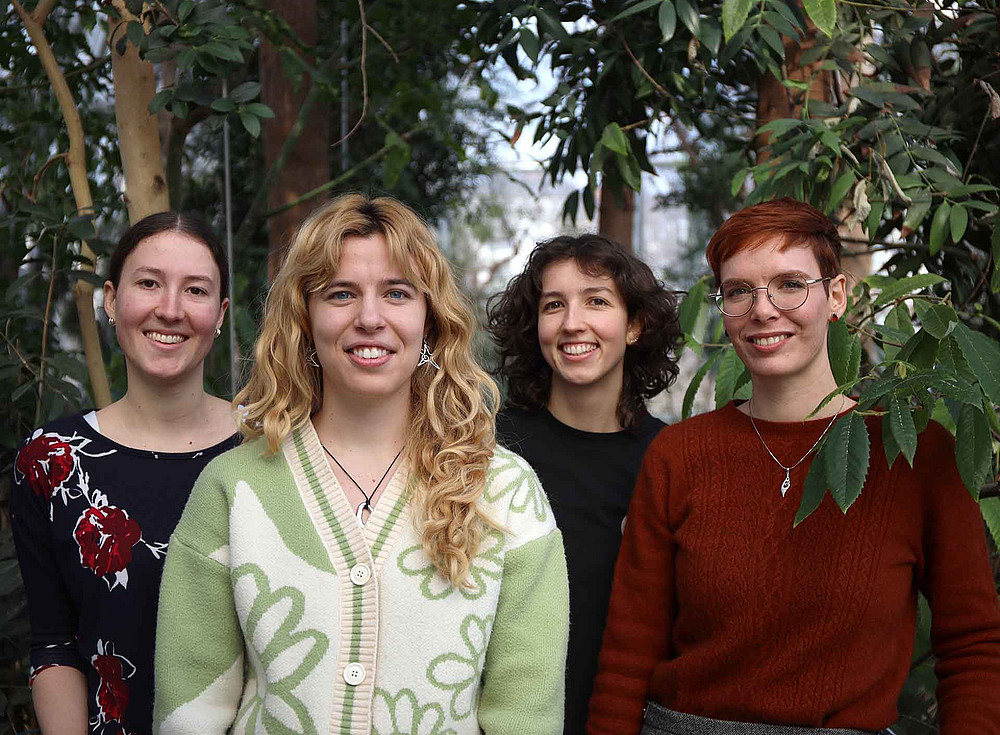
Hannah Schrettle, Sophie Döhrn, Em Hanny und Sarah Bürli (v. l.)

The project team: Hannah Schrettle, Sophie Döhrn, Em Hanny and Sarah Bürli (from left) Photo: Em Hanny

Ginkgo, kiwi, hemp: they exist as male and female plants. Anyone who paid attention in biology class will confirm this. But is this categorisation, established by Carl von Linné almost 300 years ago, still valid today? An interdisciplinary team at the University of Graz is questioning these attributions and using this as a starting point to provide food for thought for gender-sensitive interaction between students, scientific and teaching staff.

Nature is known to produce many colourful flowers. Far more than the nomenclature developed by Swedish researcher Carl von Linné in the mid-18th century, which is still used today. “The ideas of society and human sexuality at that time were transferred to plants,” explains Sophie Döhrn, a student teacher of history and English. 
“Plants reproduce in many different ways and by no means fulfil the stereotypical functions we attribute to them,” affirm biology students Em Hanny and Hannah Schrettle.
Together with Sarah Bürli, scientific director of the Botanical Garden, Döhrn, Hanny and Schrettle now want to do more than just critically examine historical names in the plant world. They take the thoughts about botanical terminology as an opportunity to raise awareness of how we treat each other. “This starts with teaching the use of gender-neutral language, extends to questions about pronouns, and goes as far as avoiding heteronormative assumptions,” the team cites a few examples.

Positive and diverse research culture 

“From Roots to Words: Rethinking How We Speak About Plants (and Us)” is the title of the project initiated by the four. The Research Careers Campus supports the project as part of the Research Culture and Integrity Ambassador Grants. Ultimately, the quartet's goal is to help shape a positive and diverse research culture at the University of Graz. The team has set itself the goal of ensuring that a more sensitive approach to one another will also transfer on scientific practice. “There are suggestions for alternative terms and categorisations for plants that are more neutral and inclusive, without compromising scientific precision,” says Sarah Bürli, referring to publications by Madelaine Bartlett and Banu Subramaniam.

The project begins with a survey to the status quo and needs of students and lecturers. ⇒ survey

Based on discussion rounds and workshops, a brochure will be produced to provide food for thought for all disciplines and raise awareness of the topic among students,scientific and teaching staff. At the same time, the project aims to contribute to the strategic goal of the University of Graz to promote equal opportunities, equality and diversity.

created by Andreas Schweiger

Related news

Handling the challenges of the postdoc career journey

Wisdom from our Uni Graz researcher community

"I was surprised by the quality of my thinking and writing!"

The first-ever PhD writing retreat took place in Deutschlandsberg Apr 9-11, 2026

Networking for Researchers: RCC goes MedUni

You're invited to a talk at the Otto Loewi Research Center on April 29!

Lightbulb moments in Spain

Read an RCC Travel Grant Report from Physics PhD Diana Shakirova

Begin of page section:
Additional information:

University of Graz
Universitaetsplatz 3
8010 Graz
Austria
  • Contact
  • Web Editors
  • Moodle
  • UNIGRAZonline
  • Imprint
  • Data Protection Declaration
  • Accessibility Declaration
Weatherstation
Uni Graz

End of this page section. Go to overview of page sections

End of this page section. Go to overview of page sections

Begin of page section:

End of this page section. Go to overview of page sections