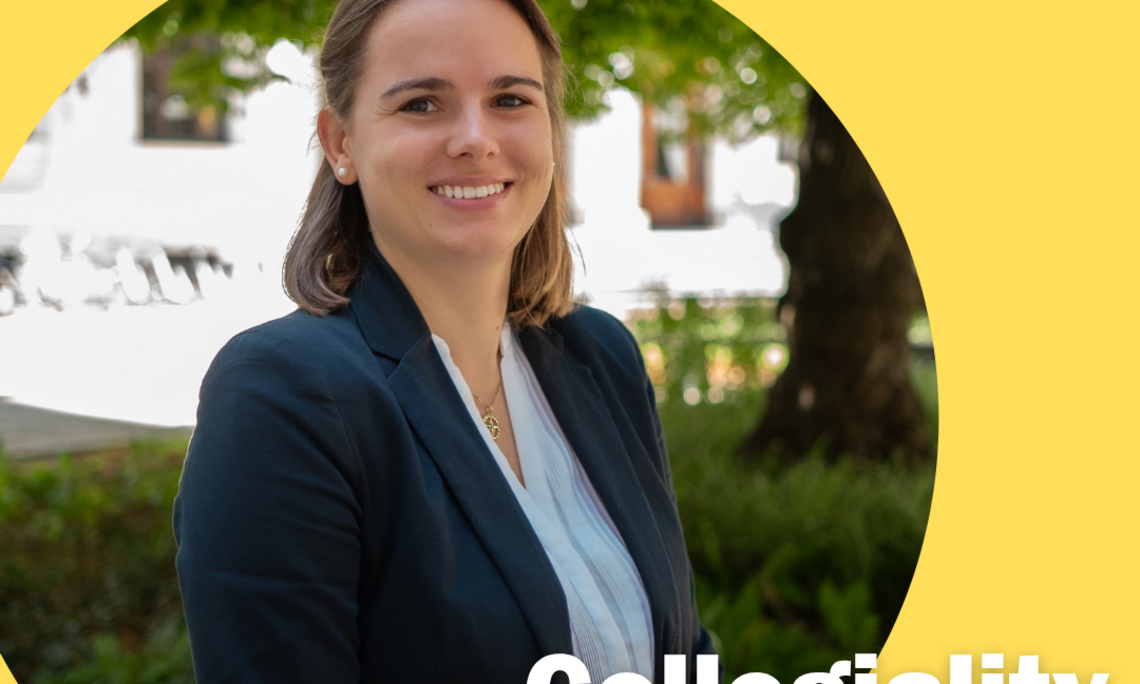




Why should good mentors shield their early-career colleagues from excessive bureaucratic duties? How do established professors keep up with the newest developments? And what can you learn from industry collaboration? We spoke to Ulrich Pferschy, Professor for Operations Research and head of the Department of Operations and Information Systems, about this and more for our latest “Collegiality Showcase”.
Ulrich Pferschy does research in the optimization of planning and decision-making processes in businesses and beyond. In addition to conducting theoretical research in discrete optimization, he is involved in a wide variety of applied projects. Recently, he has focused on renewable energy communities and electric mobility. Here are his three answers to our three questions.
1) Which activities for contributing to a positive research environment are most important in your view, and what is your personal contribution to this cause?
From my experience, it is essential to bring young researchers into contact with international colleagues as early as possible, particularly because we do not have a critical mass of researchers in my field at the University of Graz. This can be achieved by encouraging (and helping to secure funding for) participation in summer schools, workshops, and conferences, as well as through direct interaction with visiting scholars and international collaborators.
Another important aspect is shielding young researchers from excessive bureaucratic duties. As head of department, I try to minimize administrative obligations for my colleagues. I believe it is neither fair nor efficient to burden early-career researchers with necessary but time-consuming paperwork when they should be focusing on developing their research profiles. More experienced colleagues are often able to handle such tasks much more efficiently.
2) What do you personally get out of your engagement?
Engaging with young researchers allows me to stay in touch with new developments and techniques, especially since I have limited time to explore the technical details of emerging methods on my own. By following their work closely, I am often able to pick up new concepts and approaches quite efficiently.
Beyond the research perspective, working with younger colleagues also helps me remain connected to the viewpoints, expectations, and general outlook of the next generation.
3) What is your motivation for doing applied research projects with industry?
In my case, generating financial income is not the primary motivation for industrial projects, since in my research area there is fortunately little need to secure funding for equipment or consumables. However, I consider it very important to expose young researchers, in particular PhD students, to practical applications of the abstract models and algorithms we typically develop.
It is especially valuable for them to experience the challenges involved in implementing optimization procedures in real-world systems: missing or inconsistent data, unclear interfaces, incomplete information, and sometimes even poorly defined problem descriptions. This is important because such conditions may well characterize their future job environment.
In mathematics, we often begin a problem formulation with the phrase “Given x,y,z, …”. But when entering a company, nothing is simply given. Understanding this difference between theoretical and practical settings is an important part of a researcher’s education.
Beyond the educational aspect, I also enjoy incorporating anecdotes and experiences from industrial projects into my teaching. This helps make the material more realistic and more convincing for students.
Thanks a lot, Ulrich Pferschy, for taking the time to answer our questions!
The Research Careers Campus Graz showcases people and networks which shape our research environment here in Graz - towards a more collegial, friendly and diverse academia, where all research talents can thrive. More here.
Picture credit: Pferschy/privat.
Interview: Johanna Stadlbauer, RCC, 26.5.2026