


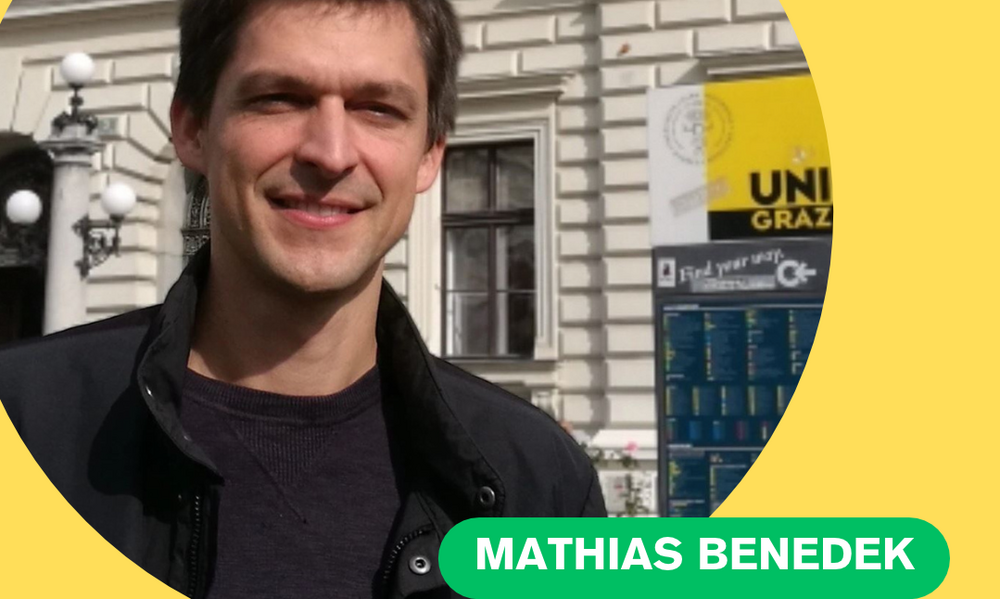
Who are the leaders fostering confidence in your work? Who helps younger researchers gain experiences of being successful and well connected? We've interviewed one: Associate professor at the Department of Psychology, Mathias Benedek, who leads the Arbeitsgruppe für Kreativität - Creative Cognition Lab.
Here are his three answers to our three questions.
1) Which activities for contributing to a positive research environment are most important in your view, and what is your personal contribution to this cause?
Working at a university is very rewarding: you're paid to follow your curiosity, you meet interesting people and places, and you have a lot of autonomy. As a creativity researcher, I also know that creative work, and science is a prime example, goes along with several positive experiences such as the chance to express one's individuality, personal growth, and a sense of competence. But you can only fully enjoy all this once you no longer have to worry about existential questions like having a job next year. Before that, the uncertainty is often stressful.
I promised myself that once I get to stay in academia, I would not take it for granted but use my new freedom to make university a better (work)place for others. So, in my lab, I try to prioritize the needs of early career scholars rather than treating them as mere workforce. In practice, this means supporting lab events, retreats and conference visits, early first- and coauthored papers, and keeping people free of tasks that delay rather than promote their development.
Early experiences of being successful and well connected make a big difference, so I try to make them possible early on: by helping people get publishing experience as soon as possible and supporting international contacts, for example through lab visits and by hosting interesting guests in the lab.
2) What do you personally get out of your engagement for a more collegial academia?
I really enjoy working with students and early career researchers. I offer writing seminars, workshops and retreats especially for PhDs, because many struggle with writing at this stage, as I did myself. It's hard to set aside regular time for it and to be confident about your own work.
It's rewarding to see people get over that hurdle and find their own voice. And I get a lot back: fresh ideas, enthusiasm, and the feeling that the lab is a place where people - including me - actually want to be.
3) What would you suggest to others who want to take first steps for becoming active in co-creating their working environment?
I learned a lot from role models, both good and bad. The good ones gave me lots of freedom, shared the excitement of making discoveries, offered early coauthoring opportunities, and truly cared about my professional development. Those are exactly the virtues I want to pass on.
My tip for people starting out is to pay attention to what you found helpful (and what you didn't) in the people you worked with, and then deliberately do the former. Leadership is mostly about creating the conditions you wish you'd had.
Thanks a lot, Mathias Benedek, for taking the time to answer our questions!
The Research Careers Campus Graz showcases people and networks which shape our research environment here in Graz - towards a more collegial, friendly and diverse academia, where all research talents can thrive. More here.
Picture credit: Benedek, privat, Interview: Johanna Stadlbauer, RCC, 20.11.2026