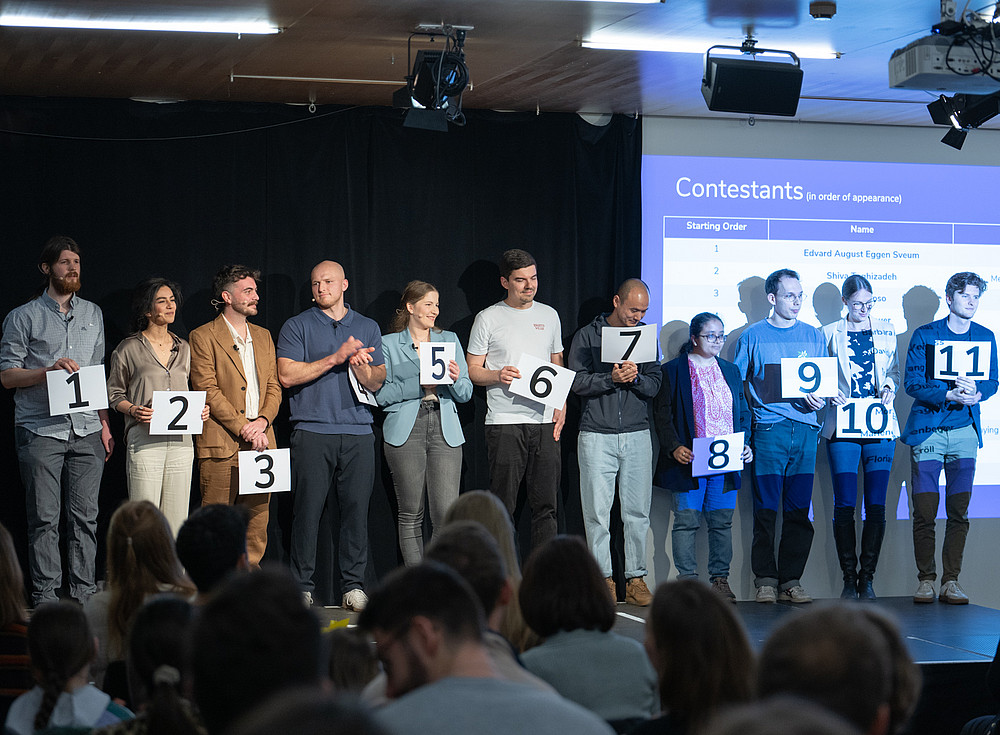
The Three Minute Thesis (3MT) Competition, originally developed by The University of Queensland, challenges doctoral researchers to present their thesis in just three minutes to a non-specialist audience. Representing a broad spectrum of disciplines across all faculties, this year’s eleven contestants showcased remarkable creativity, from using bread baking as a metaphor for the bioeconomy to hunting invisible criminals in molecular biosciences. Topics also included stretchable national borders, language barriers in legal contexts, and ecological games illustrating sustainability, all the way to the fundamental astrophysical question: “Where is everybody?” In preparation for the event, the contestants worked with science communication expert Ariane Pessentheiner, who helped them develop the perfect “story” for communicating their research.
The contestants competed for two prizes: the main award, presented by a jury of science communication experts – this year comprised of Vice-Rector Markus Fallenböck, University of Graz Museums Head Bernadette Biedermann, and last year’s 3MT winner, Bianca Brandl – and the People’s Choice Award, determined by the votes of the audience.
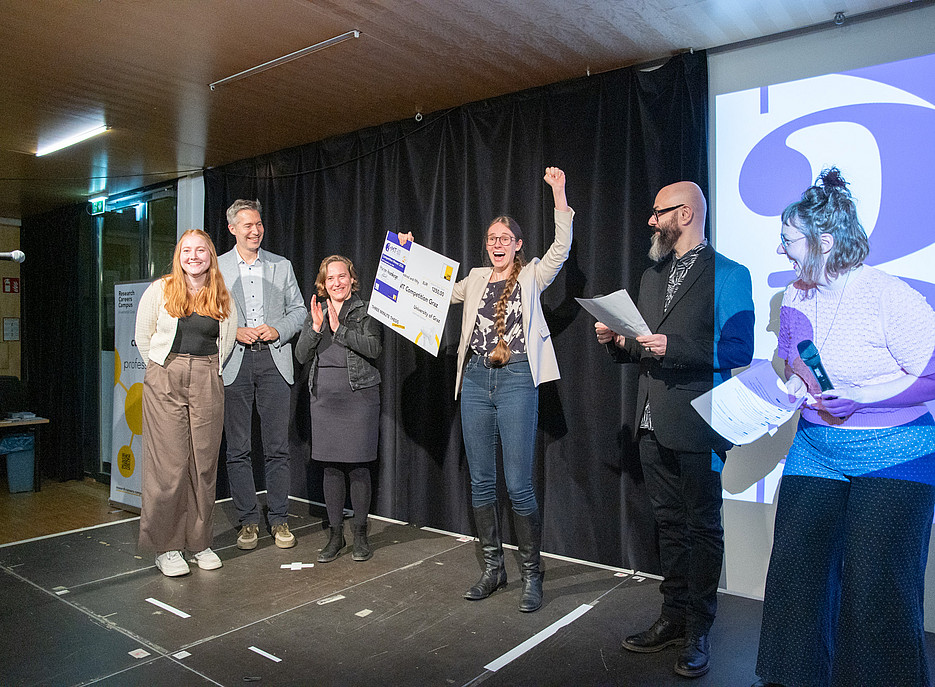
Jury Winner - Marlene Anzenberger
The competition’s main prize, accompanied by 1,250 € prize money, was awarded to Marlene Anzenberger, a doctoral candidate in International Law. Her presentation, titled “Creatures of Habit,” revolved around customary international law and the ways in which habits persist in this domain. With a raccoon lounging on a couch as the eye-catcher on her PowerPoint slide as the title-giving ‘creature of habit’, she explained how these established practices require argumentative frameworks that are both structured and flexible, an approach she is developing in her research. Marlene sums up her research: “We are all, in a sense, creatures of habit – people as well as raccoons, but also states. These habits can create law, which remains particularly relevant for the habits of states in international law. To ensure that we as humans can remain within our safe space, our daily life of habits, we need to understand how the habits of states form customary international law and thus influence our daily lives.”
Marlene was praised for turning a challenging and often dry-seeming subject into an engaging and accessible story, holding the audience’s attention throughout - undoubtedly aided by the cute raccoon on her presentation slide. Impressively, she concluded her presentation with just one second remaining on the clock.
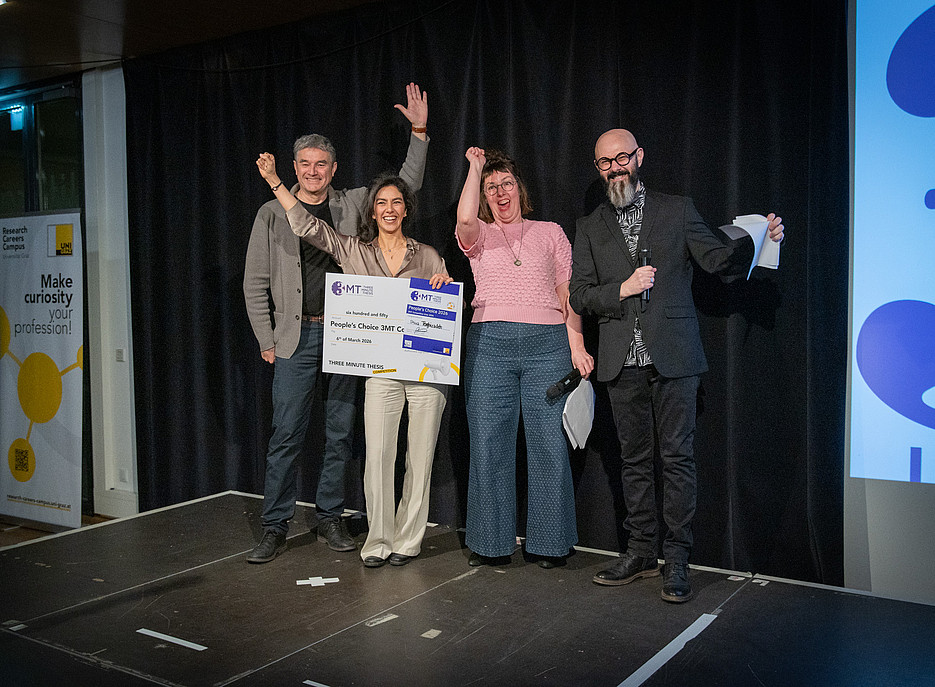
People's Choice Award - Shiva Taghizadeh
The People’s Choice Award, endowed with €650, was awarded to Shiva Taghizadeh, a doctoral candidate in psychology. In her captivating talk, “Meet your Brain’s Inner Referee: Metacognition,” Shiva explored the fascinating mechanisms through which the brain monitors and regulates its own thought processes. Her lively and relatable presentation style resonated with the audience, earning her the largest share of votes—though the margin was razor-thin, with Shiva edging out her closest competitors by a single vote.
What will happen next?
The Uni Graz 3MT Competition is part of the European Coimbra Group Competition, where participating universities submit videos of their winning presentations. From these submissions, three finalists are selected to compete live at the Coimbra Group Annual Conference, with a chance to win an additional €2,000 for first place or €1,000 as a runner-up. Uni Graz has a strong track record: its winners reached the European final in the last two years, and in 2024, Silvia Lasnik secured the overall victory. All eyes are now on Marlene Anzenberger, as we keep our fingers crossed to see if she’ll once again represent Uni Graz successfully on the European stage.