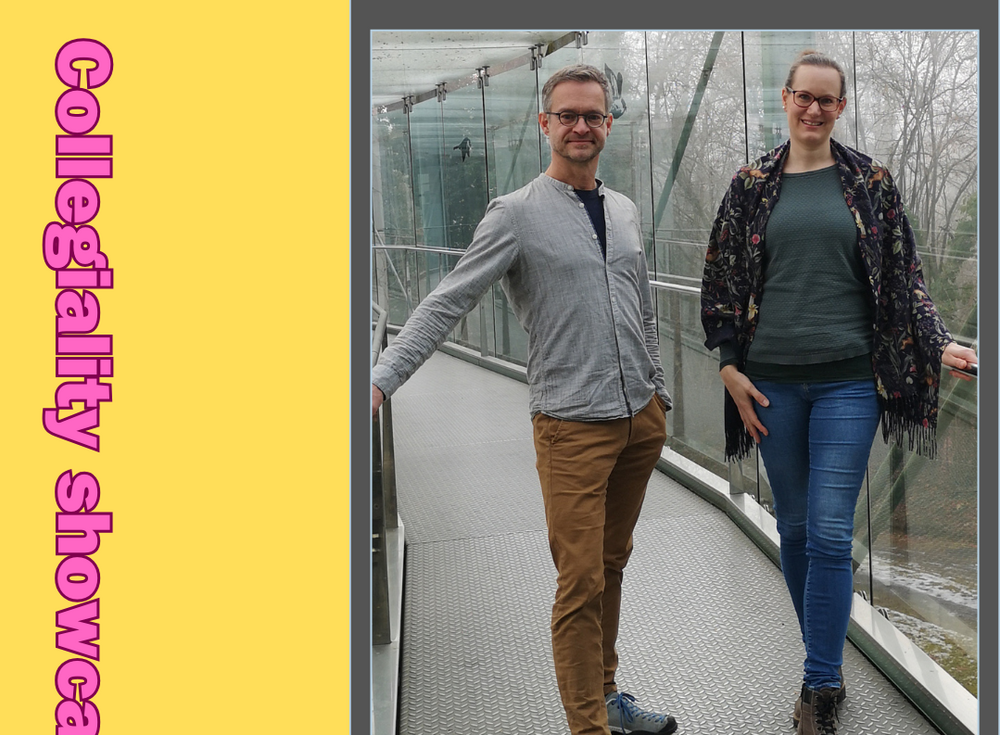
Who are the leaders who create peer communities aimed at innovating teaching practice and empowering students? We've had the pleasure to interview two of them, representing the network WAS: Senior lecturer in the Cell Biology team Alexandra Roth and adjunct lecturer in geography Alexander Doric. Here are their three answers to our three questions.
1) What is your activity called and why does it exist?
We, Alexandra (Department of Biology) and Alexander (Department of Geography and Regional Sciences), are the founders of the “Vernetzungsinitiative Wissenschaftliches Arbeiten und Schreiben (WAS) – von Lehrenden für Lehrende" (Networking Initiative for Scientific Work and Academic Writing – by Teaching Staff for Teaching Staff). WAS is a networking initiative that brings together teaching staff who lead courses on scientific work and/or academic writing. Two aspects make the WAS initiative special: First of all, WAS is a bottom-up, self-organised endeavour brought to life by members of the teaching staff rather than by the university as an employer. Secondly, WAS is intended for all members of the teaching staff at a university-wide, interfaculty level – from doctoral candidates embarking on their first teaching experience to university professors with many years of teaching expertise.
The starting point of the initiative was in 2023. At that time, Alexander had already been teaching a course on scientific work in the Department of Geography and Regional Sciences for several semesters. The idea arose to seek contact with lecturers from other departments who taught similar courses in order to exchange experiences and ideas. Consequently, he began to reach out to respective colleagues. One of them was Alexandra, who had been teaching academic writing in the Department of Biology for a few semesters and was excited about Alexander's idea from day one.
As a team, we continued to develop the idea. Since scientific work and academic writing are essential skills across all disciplines and taught in all departments at our university, we assumed that there was likely a large number of people who might be just as curious and eager to connect as we were. A dozen meetings with colleagues and many more e-mails later, it became obvious that we had been right and that we would probably find many more like-minded colleagues across our university. The plan was born to bring these people together in a networking initiative, aiming to foster exchange and enable mutual support by creating a space for teaching staff to discuss topics, needs, and problems related to their teaching in an appreciative atmosphere. Such cross-faculty collaboration among teaching staff would open up countless possibilities to exploit synergies and benefit not only the individuals involved but also the university as a whole.
The WAS initiative has been operating independently since 2024. To date, over 50 people have attended our networking events, and just as many have made use of our online resources (Moodle Course; see question 3) – and the WAS community continues to grow. Our initiative not only thrives on the ideas of our members but is also enriched by the expertise of specialists. The team of the Schreibzentrum (Writing Centre) has been on board from the very beginning, supporting us in launching our initiative and contributing their knowledge to selected networking events. In our most recent event, we were joined by staff from the Zentrum für Lehrkompetenz (Competence Center for University Teaching) and Zentrum für digitales Lehren und Lernen (Center for Digital Teaching and Learning). We are looking forward to many more fruitful collaborations with experts from inside and outside our university in the future.
2) What do you personally get out of your engagement with WAS?
Alexander:
When I look at our university, I see a place of research and science, with libraries, laboratories, and lecture halls. Above all, however, I see a place full of people, committed people. People with curious and inquisitive minds. People who are interested, but also interesting. People who are passionate about teaching their students as well as possible.
I wondered what would happen if these people were brought together. Especially if they also shared the same subject, so they could exchange experiences and ideas with each other. These considerations were based on my personal teaching interests, my fundamental curiosity about people, and the fact that I genuinely enjoy interacting with others.
“Nothing is more powerful than an idea whose time has come.” I like it when many individual parts come together to create something new that is carried by the collective energy of all those involved. My personal gain is to have contributed to the creation of this “new thing” and to be part of the team behind it. It is a wonderful experience to get an idea off the ground, to bring people into contact with each other, and to witness the dynamics of the interactions that arise; and by doing so, I am also giving something back to my university for making all of this possible for me.
Alexandra:
Networking and connecting with strangers are not exactly my forte, so I generally tend to avoid these kinds of events. I feel much more at home in a classroom, as my passion lies in teaching – particularly in my writing courses, where I guide and support my students as they start exploring their individual approaches to academic writing.
When Alexander first got in touch, I had already been collaborating with the Schreibzentrum (Writing Center) for a while to discuss ideas on how to improve my courses and course materials, but reaching out to colleagues in other departments was something I would never have considered for myself. However, Alexander’s idea of initiating a network of like-minded colleagues was compelling enough to spark my curiosity and make me leave my comfort zone. Working together to establish the initiative and chair the networking events has helped me gain confidence in speaking in front of and interacting with groups of people outside the classroom.
It has been a pleasure getting to know colleagues I would never have met if it had not been for WAS. I greatly appreciate the opportunity to gain insight into others’ approaches to the challenges that come with teaching a subject that is crucial for our students’ future success in academia and other fields of employment, yet still deeply undervalued within our academic system. I am looking forward to many more WAS events, hoping to inspire the community as much as they inspire me, drawing on what I have learned from years of teaching and from my recently completed training as a certified writing advisor. Together, we can make our university a better place for students to become not only confident and competent researchers, but also confident and competent academic writers.
3) Why should others join and how can they join?
From the conversations leading up to the founding of WAS, we learned the following: A high percentage of the people who teach scientific work and/or academic writing take this task very seriously and tend to invest exceptional effort to make their classes worthwhile for their students. However, most of these highly motivated individuals are the sole representatives of their subjects in their departments, which means they have no opportunity to reflect on their classes with like-minded colleagues, collaborate to refine course concepts, etc. If you are one of these people, WAS provides a platform for you to connect with others who are just as passionate about the subjects of scientific work and/or academic writing as you are. WAS is a community where you can bounce ideas off like-minded peers, openly address the challenges you face in your teaching, share and receive teaching materials, learn from your peers as well as from experts, and much more. WAS is a permanent work in progress that continues to develop. Due to the initiative’s participatory nature, community members can contribute on different levels – the possibilities range from participating in polls to determine the best-suited dates for our networking events and suggesting topics we should address, to assisting with the organisation of upcoming activities or actively contributing to them.
Any staff member of our university who teaches scientific work and/or academic writing or other types of writing-intensive courses, or who will do so in the foreseeable future, is welcome to join WAS. To become part of the WAS community, please send an email to vernetzungsinitiative_was(at)uni-graz.at and let us know which department you belong to. We will add you to our contact list and keep you informed about any upcoming activities related to our initiative. You will also receive the enrolment key for our Moodle Course that will give you access to our online resources.
Thanks a lot, Alexandra Roth and Alexander Doric, for taking the time to answer our questions!
The Research Careers Campus Graz showcases people and networks which shape our research environment here in Graz - towards a more collegial, friendly and diverse academia, where all research talents can thrive. More here.
Picture credit: Stabentheiner/privat.
Interview: Johanna Stadlbauer, RCC, 17.2.2026